

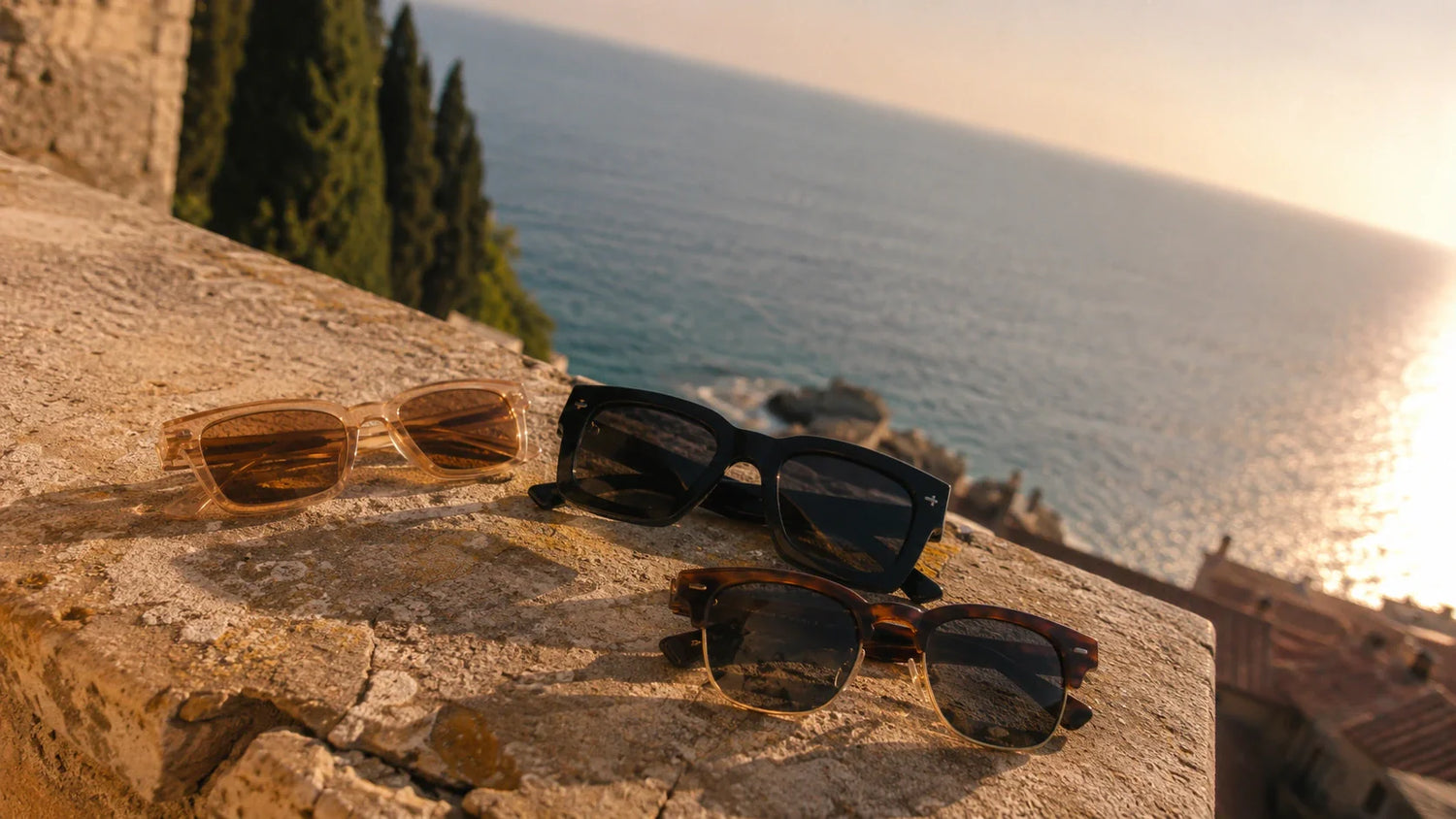
Persol is the most iconic Italian heritage eyewear brand of the last century. Founded in 1917 in Turin, worn by Marcello Mastroianni, Steve McQueen, and Daniel Craig, Persol defined what "Italian luxury sunglasses" means in popular imagination. HARO Eyewear is a much newer brand operating in the same Italian acetate tradition — quiet design, place-based naming, no visible logos — but at a fraction of the price.
We've written this comparison because customers ask about both. HARO Eyewear is our own brand. Where we make a judgement call, we say so. All Persol facts are from publicly available information on persol.com as of 2026.
How are HARO Eyewear and Persol similar?
Both brands share the foundational characteristics of considered Italian eyewear:
- Italian acetate construction (Mazzucchelli-grade block acetate).
- Hand-finished assembly, not injection-moulded.
- Mediterranean and Italian-coast design references in the heritage of each.
- Quiet aesthetic — no oversized logos on the lens or temple front.
- Polarized lens options on sunglasses.
- Shapes drawn from timeless silhouettes rather than seasonal trends.
How are HARO Eyewear and Persol different?
Heritage and ownership
Persol was founded in 1917 by Giuseppe Ratti in Turin, originally to protect pilots and sports drivers from glare. The brand patented the Meflecto flexible temple system in 1938 and the silver arrow on the temple became one of the most recognized eyewear design marks in the world. Persol has been owned by EssilorLuxottica since 1995 and operates as part of the largest eyewear group globally.
HARO Eyewear was born in Europe and debuted globally in 2025-2026. The brand is legally registered in the United States (New Mexico) and operates as an independent label — no parent group, no licensing structure. The two brands sit at opposite ends of the heritage timeline: Persol's century of operation vs HARO's first full year.
Pricing
This is the largest difference. Persol sunglasses range from approximately USD 250 to USD 500 depending on model, materials and lens technology — the iconic 649 sits around USD 280, the 714 foldable around USD 380, and the most premium crystal-lens models cross USD 500. HARO Eyewear sunglasses are USD 59 across all 36 models. HARO blue light glasses are USD 55.
Persol uses tiered pricing across the catalog — different materials, lens technologies and limited editions carry their own price points. HARO keeps a single transparent price: every sunglass model costs the same regardless of shape, colorway or material combination.
Manufacturing
Persol is Made in Italy across the full catalog. Production happens at EssilorLuxottica facilities in northern Italy, using the brand's patented techniques and proprietary lens technologies (Persol 3 polarization, crystal lenses ground in-house on premium models).
HARO Eyewear uses Italian block acetate (Mazzucchelli-grade) and polished metal where models combine materials. Assembly is hand-finished. HARO does not manufacture proprietary lens technology — sunglasses ship with polarized polycarbonate UV400 lenses as standard, with prescription fitting requiring a local optician.
Distribution
Persol sells globally through optical retailers, department stores, Sunglass Hut, LensCrafters, and via persol.com. You can try Persol frames in person in most major cities worldwide — this is one of the strongest reasons to buy from the heritage tier.
HARO Eyewear is online-only and ships to 12 markets (US, UK, EU, CH, CA, AU, NZ and others) with free worldwide shipping over USD 65 and 14-day returns. There is no physical try-on. The trade-off is global accessibility at lower price; the cost is the absence of in-person fitting.
Design philosophy and naming
Persol's heritage anchors the brand in mid-20th century Italian cinema, motorsport and aviation. The 649 worn by Marcello Mastroianni in Divorzio all'italiana (1961), Steve McQueen's 714 foldable in The Thomas Crown Affair (1968), and the brand's continued use in James Bond films keep the design language firmly in that cultural register. Model names are numerical (649, 714, 3019, etc).
HARO Eyewear names every frame after a specific Mediterranean coastal place or Alpine winter destination: Cannes 1946 (the first Cannes Film Festival), Capri Malaparte (Curzio Malaparte's 1942 cliffside house), Sanremo 1947 (the Belle Époque Ligurian villa era), Sorrento Grand Tour (the historic Grand Tour endpoint), St. Moritz '19 (the Belle Époque resort). The naming anchors each model in a specific cultural and geographical reference rather than a model number.
Lens technology
Persol offers proprietary lens technologies on premium models: Persol 3 polarization (three-layer polarized lens construction), and crystal lenses (mineral glass, ground in-house) on the top tier. These add to the price but represent a meaningful technical advantage.
HARO Eyewear ships with polarized polycarbonate UV400 lenses as standard. Crystal lenses are not offered. For prescription, HARO frames need to be taken to a local optician.
Quick comparison table
- Founded: Persol (1917, Turin, Italy) vs HARO Eyewear (2025, born in Europe, US-registered).
- Ownership: Persol owned by EssilorLuxottica since 1995 vs HARO independent.
- Price: Persol USD 250-500+ vs HARO USD 59 (sunglasses) / USD 55 (glasses).
- Pricing structure: Persol tiered by model vs HARO single price across all models.
- Manufacturing: Persol Made in Italy (EssilorLuxottica facilities) vs HARO uses Italian acetate, hand-finished assembly.
- Distribution: Persol global optical retail + online vs HARO online-only in 12 markets.
- Frame material: Both use Italian acetate; Persol offers crystal lenses on premium models.
- Lens technology: Persol 3 polarization + crystal vs HARO polarized polycarbonate UV400.
- Naming: Persol numerical (649, 714) vs HARO place-based (Cannes 1946, Capri Malaparte).
- Returns: Persol 30 days vs HARO 14 days.
- Free shipping: Persol varies by region vs HARO free worldwide on orders over USD 65.
Where does Persol win?
- Heritage and brand equity. A century of operation, iconic cinematic association, recognizable design marks.
- Proprietary lens technology. Persol 3 polarization and crystal lenses are real technical advantages at the premium tier.
- Made in Italy manufacturing across full catalog. Full vertical integration through EssilorLuxottica.
- Global physical retail. Try-on in most major cities worldwide.
- Longer return window. 30 days vs 14 days.
- Resale and collector value. Vintage Persol models retain and gain value; HARO does not have a secondary market yet.
Where does HARO Eyewear win?
- Price. USD 59 vs USD 250-500 is a substantial difference, particularly if you want multiple pairs for different occasions or seasons.
- Single transparent pricing. No premium for specific shapes, colorways or materials — the same model in tortoise costs the same as in crystal.
- Place-based naming. Each frame ties to a specific cultural and geographical reference rather than a model number, which appeals to buyers who want narrative depth.
- Wider experimentation budget. At HARO prices, buyers can own a round, a browline, an aviator and a wayfarer without crossing the cost of a single Persol.
- Free worldwide shipping in 12 markets. Currency-localized pricing built in.
- Independent brand. No parent group — relevant if buyer prefers supporting smaller labels over Luxottica-owned brands.
Which brand should you choose?
It comes down to three personal factors:
Your budget
If your budget is USD 250+ per frame and you value heritage, proprietary lens technology, and the long-term resale potential, Persol is in a different tier and rewards that investment. If your budget is below USD 100 and you want Italian acetate construction with refined design, HARO Eyewear is exactly that tier.
What you value in a frame
If you want a single iconic frame backed by a century of brand equity — and you'll keep it for a decade — Persol. The 649 and 714 have aged well precisely because they were correct designs in 1961 and 1968 respectively, and they remain correct now. If you want flexibility to own several frames covering different shapes and contexts at the price of one Persol, HARO Eyewear.
How you buy eyewear
If you prefer to try frames in person, walk into a Persol-stocking retailer in your city. If you prefer to buy online with a 14-day return window, HARO Eyewear is built around that model. If you want prescription lenses integrated at point of purchase, Persol via an optical retailer is more seamless; with HARO, you'd take the frame to a local optician.
Three HARO frames worth a closer look
- Cannes 1946 — round acetate sunglasses named after the first Cannes Film Festival. USD 59.
- Capri Malaparte — modernist browline in acetate and metal, referencing Curzio Malaparte's 1942 cliffside house on Capri. USD 59.
- Sorrento Grand Tour — hexagonal aviator referencing the Grand Tour's historic endpoint at Naples. USD 59.
For the broader Italian eyewear context that places both brands among the wider field, read our Best Italian and Italian-Inspired Sunglasses Brands 2026 guide. For Italian-coast aesthetic specifically, the Italian Coast Sunglasses Guide covers the cultural references that anchor HARO's naming.
This comparison was written by the HARO Eyewear editorial team. Where we cite Persol facts, we've used publicly available information from persol.com as of 2026. Pricing approximations are subject to change.


Laisser un commentaire
Ce site est protégé par hCaptcha, et la Politique de confidentialité et les Conditions de service de hCaptcha s’appliquent.